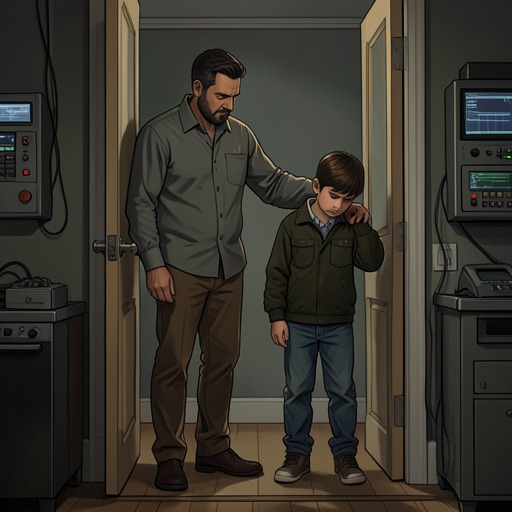
Hacine Returns to Heillange and Reunites with His Father
And Their Children After ThemHacine Returns to Heillange and Reunites with His Father is a homecoming after two years of absence, but not a triumphant return. Hacine arrives with fear and shame, the last of his savings, and an ax handle he has carried while imagining a confrontation. At his father’s door, that imagined reckoning loses its force: the old man welcomes him, and Hacine dismisses the weapon as pointless. The scene turns the return from a performance of anger into a fragile reunion, while leaving the failures and injuries that drove Hacine home plainly in view.
Causes of the Return
Hacine’s return follows the collapse of ventures in Morocco that he and Driss had backed. Letters arrived from Saida, Eassouira, and Nador, where they had invested their capital. Work had begun, workers wanted their wages, and officials demanded baksheesh; the legal documents authorizing the projects bore both men’s signatures. Their losses therefore did not end with the money already invested: they were being pressed for enormous additional sums.
At first, Hacine and Driss ignored the demands. The pressure escalated from further letters, handwritten and abusive, to threats. A fire broke out in the stairwell of the building where Hacine and his family lived, and the two men began to feel watched and mistrustful. Then Driss was seized near the Beaux-Arts: two men held him while a third gouged out his eye with a screwdriver. They paid after the attack. Hacine decided that the enterprise was over, and his father’s heart problems gave him another reason to go home. His departure is thus both an exit from a dangerous failure and a response to the vulnerability of a parent aging in his absence.
The Road and the Rumor of His Return
Two years after leaving, Hacine set out for Heillange. Near Niort he pulled off the highway for coffee at a small Total gas station. It was after six in the evening; he had been driving since morning without speaking and had scrupulously obeyed the rules of the road. When he could no longer wait to urinate, he used a water bottle, which rolled around on the carpeted passenger-side floor. The detail makes the journey bodily and depleted rather than celebratory: he keeps moving, but even this ordinary need is dealt with in the car.
As he climbed the stairs to his father’s apartment, Hacine remained absorbed in the disaster he had just left behind and held the ax handle in silence. A neighbor boy passed him going down. Only after taking four more steps did the boy recognize the thin figure as Hacine Bouali. In the neighborhood, the two-year absence had acquired its own story. People had heard he was making out like a bandit; his friends had received postcards from the Balearic Islands and the Costa del Sol, and their envy sat alongside their resentment. Whatever those postcards suggested, Hacine came back with the last of his savings, not the fortune people imagined. The boy hurried to spread the news because many had assumed Hacine was gone for good.
At His Father’s Door
Hacine reached the third floor without getting the chance to ring: the door opened of its own accord, and his father was there with a broad smile. The welcome immediately unsettles the confrontation Hacine had prepared for. During the trip, he had rehearsed scathing things to say. Facing his father in the building where he had grown up, he could no longer make those intentions seem meaningful. They appeared to him for what they were: a show.
The reunion is physically brief. Father and son hug, and the father notices the ax handle. Hacine’s father is more stooped and darker-skinned than before, but Hacine is glad to see that he looks well. He has taken up playing boules with former workmates, an activity that gives him something to do and brings the men outside for fresh air. This small account of his father’s routine counters the return’s looming violence with evidence of a life continuing in Hacine’s absence. The father is not presented as a figure awaiting a quarrel; he is an old man, gentle, forgetful, and weary, glad that his son has come back.
The Ax and the Reversal
When his father asks what the ax handle is for, Hacine answers that it is for nothing and calls it stupid stuff. The reply marks the scene’s decisive reversal. The object has accompanied him up the stairs while he brooded over failure and imagined what he might say; in the presence of his father, its implied threat has no purpose. The evidence does not turn the reunion into a reconciliation of every past grievance. Instead, it records a narrower change: Hacine’s prepared hostility collapses when he sees his father’s age and welcome, and the weapon is reduced to an empty gesture.
The homecoming holds embarrassment and tenderness together without erasing either. Hacine has returned from a scheme that brought financial demands, threats, and a brutal attack on Driss; neighbors have mistaken distance for success; and his father’s heart problems have sharpened the urgency of coming back. Yet the encounter itself is quiet: an opened door, a short embrace, a glance at the ax, and a deflating explanation. The return matters because the expected showdown does not occur. Hacine reaches the home he once left carrying anger, but at the threshold he can no longer sustain it.